
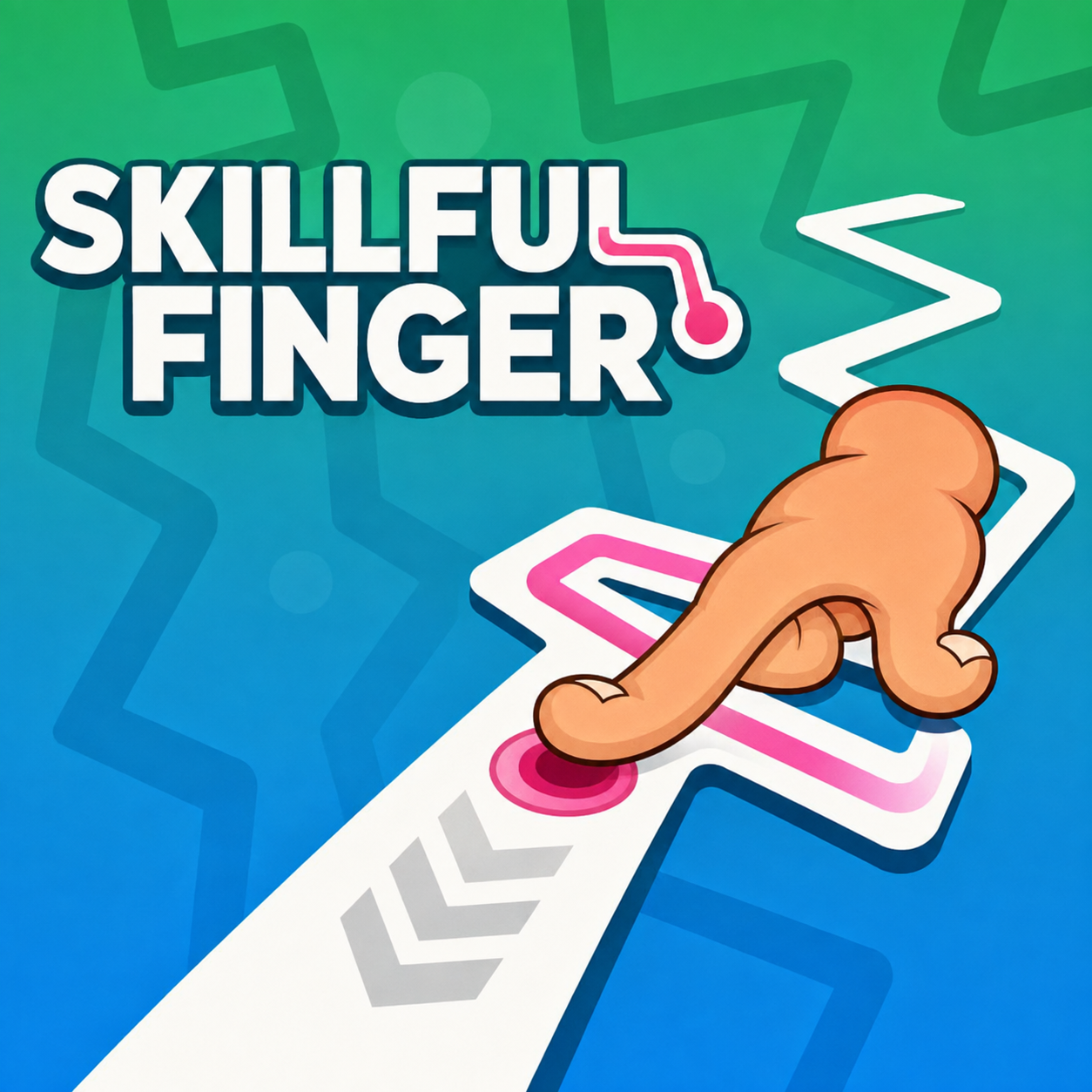




Skillful Finger Mods Game







How To Play Skillful Finger
The heart of Skillful Finger lies in a straightforward control system that anyone can pick up in just a few seconds. On a desktop setup, the player presses and holds the left mouse button while moving the mouse to guide the ball along the track. The ball is required to stay inside the safe zone at all times; any contact with the boundary instantly terminates the attempt. On a compatible touchscreen, the player merely places a finger on the display and drags it to direct the ball in the desired direction. Letting go of the mouse button or raising the finger halts forward motion, giving the player the chance to pause and think before moving on. This stopping feature is by no means a drawback; rather, it ranks among the most essential tools available in the entire game.
The track is never stationary. The path continually curves, tightens, and slides laterally, compelling the player to predict what lies ahead. Since the camera advances forward, waiting until a hazard is directly in front before responding is frequently too late. A far more dependable strategy is to place the ball in the correct position prior to entering a challenging segment. On broader stretches, keeping near the middle of the route leaves additional space for the subsequent adjustment. This minor practice can determine whether a run goes smoothly or ends in a sudden crash.
In later stages, moving barriers appear that traverse the safe route. These hazards demand careful timing rather than simple steering alone. A passage might appear clear, yet by the moment the ball reaches it, the barrier could have moved to seal that opening. The optimal tactic is to observe the barrier's motion before altering course. If the path does not look accessible, the player ought to pause instead of making a dangerous dash through a tight opening at full velocity.
The player is never obliged to remain in motion. Releasing the mouse button or taking a finger off the screen makes the ball cease its forward progress. From that point, the ball can only resume by pressing and holding the left button once more. This ability proves especially useful in dense obstacle arrangements, as it allows the player to hold back until a secure opening appears. There is no visible countdown timer in the game, and the track does not compel constant movement; the player is free to stop whenever necessary. In many situations, precise timing proves far more effective than raw speed.
Coins are scattered along the course, and gathering them is entirely optional. Certain coins rest in secure lanes, while others are positioned just beyond the safest route, presenting a genuine trade-off between risk and reward. A player may choose to bypass them entirely for a cautious, clean run, or opt for a bolder trajectory to collect additional currency. These collectibles serve to unlock cosmetic options, including various ball designs and trail effects. This mechanic gives the game a cyclical sense of motivation without requiring the player to deal with an intricate progression or upgrade framework.
Advancement occurs as the player finishes additional runs, yet it does not come through unlockable systems. The challenge escalates organically as the game adjusts its pace and emphasizes score. Higher speeds reduce the time available to interpret forthcoming segments, while increasingly intricate obstacle layouts require more refined positioning. Mastery is built upon three core abilities: accuracy, timing, and foresight. Every successful run is simply a further expression of these fundamental skills.
Skillful Finger Wiki
Summary
Skillful Finger is a precision-focused arcade experience that condenses its entire challenge into one uninterrupted action: steering a ball through a constantly shifting course while avoiding edge contact and obstacle collisions. At first glance, the rules seem almost deceptively straightforward. You press a button, guide the ball, and steer clear of danger. In reality, Skillful Finger soon demonstrates that its true excitement lies in maintaining control under intense pressure. Since every attempt ends the instant the ball touches an obstacle, failure arrives immediately—but so does the opportunity to restart. This streamlined cycle of brief runs, instant feedback, and gradual improvement makes the game especially attractive to those who enjoy pure, skill-driven gameplay.
There is no elaborate storyline, no character leveling, and no inventory system to manage. Instead, the game generates tension through movement and reaction. The active path rarely stays straight for long; it repeatedly twists, tightens, and alters direction. As a run continues, additional variables steadily raise the overall difficulty. The game takes the standard precision-runner formula and introduces a more deliberate, measured tempo, ensuring that timing carries as much weight as raw reflexes. The result is a test of steady hands, sharp eyes, and the discipline to wait for the safest possible moment to advance.
Skillful Finger is ultimately a lesson in consistent response. A player who maintains a centered position, anticipates the upcoming section of track, and makes smart use of the pause feature is far more likely to achieve a long run than someone who simply moves as quickly as possible. Button presses are not purely about speed; they are about positioning, commitment, and the ability to adapt in the moment.
Key Features
Skillful Finger offers a clear set of features that reinforce its arcade-style design:
- Precision-based controls with a direct and immediate connection between input and movement.
- A continuously evolving track that bends, curves, narrows, and shifts direction.
- Moving barriers that demand proper timing and challenging adjustments.
- A stop function that lets the player pause and wait for safer openings.
- Collectible coins that introduce a risk-versus-reward element for customization.
- Cosmetic options for customizing the player ball and its trail.
- Difficulty progression through moderate speed increases and layered obstacles.
- A simple, responsive input system designed for both desktop and touchscreen play.
These features keep the focus on moment-to-moment decision-making rather than complex instruction manuals or weapon and armor menus. The game embraces the idea that a challenging runner built on movement and sequencing can be understood through direct control. Newcomers can jump in without a tutorial, while experienced score chasers can dedicate themselves to mastering precise movement routes and boost patterns.
Precautions/Tips
The most essential rule for a successful run is to remain in control. Quick, erratic movements tend to cause more collisions than a slightly slower but more patient approach. Rushing through at high speed may feel instinctive, but the risk usually outweighs the benefit.
Always anticipate the next portion of the path, especially when you reach a safe zone. It is far better to approach a curve correctly than to attempt a last-second correction once the curve is already visible on screen. If a wide area is available, use that extra space to bring the ball back to the center. This reduces the likelihood of an edge collision when a difficult obstacle suddenly appears.
The stop mechanic should never be overlooked. There will be moments when a moving obstacle crosses the path and no gap appears safe. It is perfectly acceptable to halt and wait. Over time, you will recognize which obstacles require immediate crossing and which are better handled with a brief pause. In many situations, a patient player will see exactly when the opening becomes safe.
Avoid chasing coins that are placed in dangerous positions, especially when the path is narrow. Some coins are positioned in a way that seems to invite risking your run for a small reward. Before going after currency, examine the upcoming obstacles. If a coin sits too close to a barrier or near a moving hazard, it may be wiser to leave it behind. A longer run is generally more valuable than a single coin, and surviving longer will naturally yield more coins over time.
On touchscreen devices, remember the importance of a steady finger. Hold the screen firmly and avoid sudden changes in position. The act of lifting your finger to trigger the stop function can be costly, as it briefly removes you from control. During an active run, do not release your finger unless you intend to stop.
Finally, if your goal is to surpass a personal best score, keep risk to a minimum until the game itself makes further progress impossible. The best runs come from refusing to touch the edges, not from attempting to be overly aggressive at every turn. With consistent practice and careful observation, even the game's most difficult patterns become manageable. You will no longer need to depend on extreme reflexes; instead, you can read the path, decide when to pause, and complete a far more confident run.
Skillful Finger Frequently Asked Questions
Q: What is Skillful Finger?
A: Skillful Finger is an arcade game centered on precision, in which players navigate a rolling ball along narrow corridors while avoiding contact with walls or barriers.
Q: What is the main objective in Skillful Finger?
A: The primary goal is to remain within the designated safe route, evade all obstructions, and steadily increase your score as the level of difficulty escalates over time.
Q: How do I control the ball on desktop?
A: On a computer, press and hold the left mouse button to take command of the ball. Move the mouse to guide it left or right, then release the button to bring it to a halt.
Q: How do I control the ball on mobile?
A: On touchscreen devices that are supported, touch and keep your finger on the screen to control the ball, drag to change direction, and lift your finger to stop.
Q: What happens if I touch the border or an obstacle?
A: Making contact with the boundary or any obstacle will instantly terminate your current attempt.
Q: Are sharp movements safe in Skillful Finger?
A: In Skillful Finger, gentle and gradual movements tend to be far safer than abrupt corrections, since even a single collision with the border or an obstacle ends the run.
Q: How does the track change during a run?
A: The path frequently bends, narrows, and alternates from one side to the other. Because the screen keeps advancing forward, you must place the ball in the right position before reaching more confined sections.
Q: Where should I position the ball in wider areas?
A: In broader sections, staying near the middle provides more room to react when the next curve or obstruction appears on screen.
Q: How do moving obstacles work?
A: Certain segments feature barriers that travel across the available path. You need to determine when a gap will become passable and pay attention to the obstacle's movement direction before making your move.
Q: Can I stop moving to wait for obstacles?
A: Absolutely. Releasing the mouse button or taking your finger off the screen halts forward progress, letting you wait until moving obstacles reach a safer position. Press and hold again to resume.
Q: What are coins used for in Skillful Finger?
A: Coins gathered during a run can be spent on cosmetic unlocks, including alternative ball designs and visual trail effects.
Q: Is collecting coins risky?
A: Yes, because certain coins are placed away from the safest route. Going after them demands extra maneuvering, which raises the likelihood of striking an obstacle.
Q: How does difficulty increase in Skillful Finger?
A: The challenge ramps up through higher speeds and more intricate obstacle patterns. You get less time to analyze upcoming sections and fix poor positioning, while moving barriers become harder to predict when they are combined with narrow passages and shifting track directions.
Q: What skills are needed to progress in Skillful Finger?
A: Advancement relies on precision, timing, and foresight. You must execute controlled movements, exercise patience for safe openings, and consistently scan ahead so the ball is positioned early.
Q: Are there upgrades or combat systems in Skillful Finger?
A: No. There are no complex upgrade trees or combat mechanics to worry about. Improvement comes primarily from mastering the core gameplay and becoming more consistent with each attempt.