
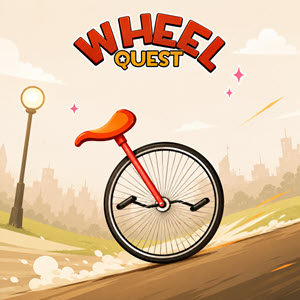







Wheel Quest Mods Game
















How To Play Wheel Quest
The core experience of Wheel Quest revolves around a singular yet challenging gameplay element: preserving equilibrium atop a shifting unicycle. The player character persistently tilts in reaction to the wheel’s movement, demanding that users execute subtle and accurate adjustments to maintain an upright posture. Mastery is achieved by interpreting the landscape and responding with smooth, well-timed controls. Beyond this fundamental task, the game introduces additional layers of complexity as the terrain varies, offering slopes, obstacles, and uneven surfaces that test the rider's ability to adapt. Success in Wheel Quest relies on a blend of concentration, dexterity, and an understanding of momentum, ensuring that each attempt feels both demanding and rewarding. The design encourages players to develop a keen sense of balance, transforming every ride into a test of skill and patience.
Wheel Quest Wiki
Summary
Wheel Quest is a physics-driven unicycle game presenting players with a seemingly straightforward objective: maintain balance and travel as far as possible. The core experience centers on the delicate art of equilibrium, where each movement, incline, depression, and leap introduces a fresh opportunity for the rider to fall. The game’s primary attraction stems from its unpredictable physics system, which rewards precise, considerate control and penalizes overcompensation or hesitation. As players advance, they face progressively challenging landscapes and unlock additional unicycles, offering a persistent drive to surpass their personal farthest distance. In spite of its minimalistic controls and uncomplicated premise, Wheel Quest delivers a remarkably profound challenge that evaluates both reflexes and strategic patience. It is a game crafted for those who value the tension between simplicity and difficulty, where achievement is measured not in conquered stages but in meters endured.
Overly resolute corrections can trigger a sway that rapidly escalates into a tumble, whereas delayed responses leave the rider vulnerable to gravitational forces.
Players commence on level ground, enabling them to establish a rhythm and grasp the fundamental handling of the controls. As the ride progresses, the pathway presents depressions that disrupt the wheel’s steadiness, inclines that modify speed and travel angle, and leaps that require a stable landing. Each of these impediments demands a distinct strategy: foreseeing a depression by modifying the tilt before contact, appropriately shifting weight on an incline, and readying for the landing’s impact to soften the shock.
The controls are deliberately minimal, allowing players to concentrate solely on balance. On PC, the left and right arrow keys are used to tilt or shift the rider. On mobile devices, tapping the left or right side of the screen accomplishes the same effect. The straightforwardness of the input method obscures the gameplay’s depth, as each tap must be deliberate and purposeful.
The game encourages players to begin slowly and closely monitor the rider’s tilt angle. Short, quick taps are more effective than maintaining a direction for a prolonged period, as they permit finer control and swifter adjustments. It is also crucial to watch the path ahead—preparing for upcoming obstacles early is significantly simpler than attempting to restore balance at the final moment. Rough segments should be navigated with caution, and players should adjust their stance before reaching inclines or leaps. The ultimate aim is to gradually enhance one’s distance, treating each additional meter as a personal achievement.
Key Features
- Physics-Centered Balance System: The fundamental mechanic relies on a realistic physics engine that replicates the rider’s lean and the wheel’s momentum. Every input has a proportional effect, rendering the game both instinctive and unforgiving.
- Dynamic Terrain Challenges: The path is not uniform. Depressions, inclines, and leaps continuously disrupt the player’s rhythm, demanding adaptive strategies and swift thinking. The terrain grows more challenging as the player advances, ensuring the difficulty escalates naturally.
- Unlockable Unicycles: As players travel further and achieve superior distances, new unicycles become accessible. These cosmetic or performance variations enhance replay value and provide players with a tangible reward for their perseverance.
- Minimalist Controls with Elevated Skill Requirement: The control layout is extremely simple—only two directions—yet perfecting it requires fine motor control and split-second choices. This contrast between ease and complexity is a hallmark of the game’s design.
- Endless Runner Framework: The game lacks set levels or endpoints. The sole objective is to continue riding and surpass your previous best distance. This format encourages repeated attempts and self-enhancement rather than linear progression.
- Cross-Platform Compatibility: The game is fully functional on both PC (with arrow keys) and mobile devices (with touch controls), making it available to a broad audience without compromising the core experience.
Precautions/Tips
- Refrain from Overcompensation: One of the most frequent errors is reacting too forcefully when the rider begins to tilt. A large, sustained input can amplify the wobble rather than correct it. Employ short, gentle taps to guide the rider back into a stable position.
- Predict, Do Not Respond: The most successful players keep their focus on the path ahead. By identifying inclines, depressions, and leaps several seconds in advance, you can modify your balance before the obstacle affects the wheel. Last-moment corrections are seldom effective.
- Preserve a Consistent Rhythm: On level segments, attempt to discover a comfortable, steady tapping pattern. This helps you establish a baseline of stability that can withstand minor disruptions. Abruptly changing your rhythm can result in lost control.
- Handle Leaps with Caution: When approaching a leap, ready yourself for the landing by centering the rider’s lean. The moment of impact is crucial—if you are tilting excessively in any direction, the landing will almost certainly cause a fall. Aim to touch down with the wheel as level as possible.
- Gradual Enhancement: Do not anticipate doubling your distance in a single attempt. Concentrate on improving by a few meters each run. This approach diminishes frustration and fosters a steady sense of advancement. Even a minor gain is a victory.
- Incorporate Breaks: The game’s physics can be mentally draining. If you notice yourself making repeated mistakes, step away for a few minutes. Returning with a refreshed mind often leads to improved performance.
- Experiment with Unicycles: Different unicycles may exhibit subtle differences in physics or handling. Test them to see if any align better with your playing style. Unlocking and trying new options can also alleviate monotony and provide renewed motivation.
- Monitor Your Posture (For Mobile Play): Holding the device in a steady position can help you control screen taps more accurately. Unsteady hands can translate into unsteady in-game balance.
Wheel Quest Frequently Asked Questions
Q: What is Wheel Quest?
A: Wheel Quest is a simulation-based one-wheel riding game that focuses on maintaining equilibrium on a single tire while aiming to cover the greatest distance possible without toppling over. The difficulty arises from unpredictable ground features such as dips, inclines, and leaps.
Q: What is the primary goal in Wheel Quest?
A: Your task is to maintain careful equilibrium, traverse the maximum distance, and surpass your own personal record.
Q: How does the motion system function in Wheel Quest?
A: Your character naturally tilts as the wheel progresses, requiring subtle adjustments to maintain stability. Exerting too much force causes instability, and hesitating too long results in a fall.
Q: What kinds of surfaces can I anticipate in Wheel Quest?
A: You will experience level stretches for rhythmic movement, uneven patches, holes that disrupt balance, slopes that alter speed, and obstacles that demand controlled descents.
Q: Are there benefits for advancing further in Wheel Quest?
A: Indeed, as you progress to greater distances, more difficult paths and extra unicycles are unlocked, offering additional motivation to pursue a higher score.
Q: What is the fundamental approach to succeed in Wheel Quest?
A: Begin gently and observe your rider's tilt. Use delicate inputs instead of holding a button for extended periods. When the figure begins to lean, respond swiftly to prevent the instability from turning into a complete fall.
Q: What method should I use for irregular surfaces in Wheel Quest?
A: Focus on the path ahead and anticipate dips or inclines early. It is far simpler to prepare in advance than to attempt to recover your unicycle at the final moment.
Q: What are the keyboard commands for Wheel Quest on PC?
A: Press the Left Arrow key to tilt or shift left, and press the Right Arrow key to tilt or shift right.
Q: What are the touch controls for Wheel Quest on mobile devices?
A: Tap the left portion of the screen to tilt or move left, and tap the right portion of the screen to tilt or move right.
Q: What is an essential suggestion for achieving better handling in Wheel Quest?
A: Employ brief taps rather than sustained holds to achieve improved control and correct your balance promptly.
Q: How should I manage bumpy segments in Wheel Quest?
A: Navigate rough areas with caution and modify your positioning before encountering slopes or leaps.
Q: What attitude should I adopt when aiming to enhance my distance in Wheel Quest?
A: Concentrate on marginally exceeding your previous distance step by step. Gaining just a few extra meters counts as a success when your only companion is a highly unstable wheel.
Q: What makes Wheel Quest difficult despite its straightforward controls?
A: The game maintains minimal controls while offering a surprisingly substantial challenge. The straightforward yet erratic physics make remaining upright a significant task.
Q: What action should I take when my rider begins to lean in Wheel Quest?
A: Execute a prompt adjustment before the instability develops into a complete fall.
Q: What other games are comparable to Wheel Quest?
A: Alternative games to explore include Wacky Steps and Slope Xtreme.