


Obby Tower Mods Game




How To Play Obby Tower
The fundamental gameplay cycle of Obby Tower revolves around traversing a skyborne environment through exact leaps, deliberate bursts of speed, and thoughtful problem-solving. Prior to starting a session, players must choose a stage setting, with the two starting choices being Playground and Rainbow. Each stage offers a distinct arrangement of barriers, hazards, and aesthetic motifs, which shapes the overall feel of the experience. Afterward, the player selects a difficulty level—Easy, Medium, or Hard—that directly determines the intricacy of the platforming and the way challenges are organized.
The core action consists of two main, interconnected activities. Players move using conventional first-person controls, which demands that they convert spatial awareness into precise inputs. Being skilled at gauging leap distance and trajectory is essential, since platforms differ in dimensions and certain ones are mobile or obstructed. A crucial element of success lies in mastering the sprint mechanic. It supplies the additional momentum needed for wide chasms, yet it also raises the chance of flying past smaller ledges, so learning when to employ it becomes a fundamental ability. Additionally, the game forces players to halt and resolve arithmetic problems presented as gateways or on-screen prompts. This design element induces a shift in mental focus, demanding calmness to carry out calculations while standing on unstable ledges in a three-dimensional space.
Advancement is safeguarded by checkpoint markers, represented by a rotating "C" placed along the route. When players reach and contact these markers, the game state is saved, so that after a fall, respawning occurs at that location instead of at the start. Beyond the obvious parkour barriers, players must also choose which of several multiple-choice platforms to land on. This cross-disciplinary method, merging physical action with rapid mental assessment, establishes the game's distinctive challenge identity. Through the settings and control menus, players can alter their viewpoint, a feature that proves vital for certain leaps or when examining puzzle elements from different angles.
Obby Tower Wiki
Summary
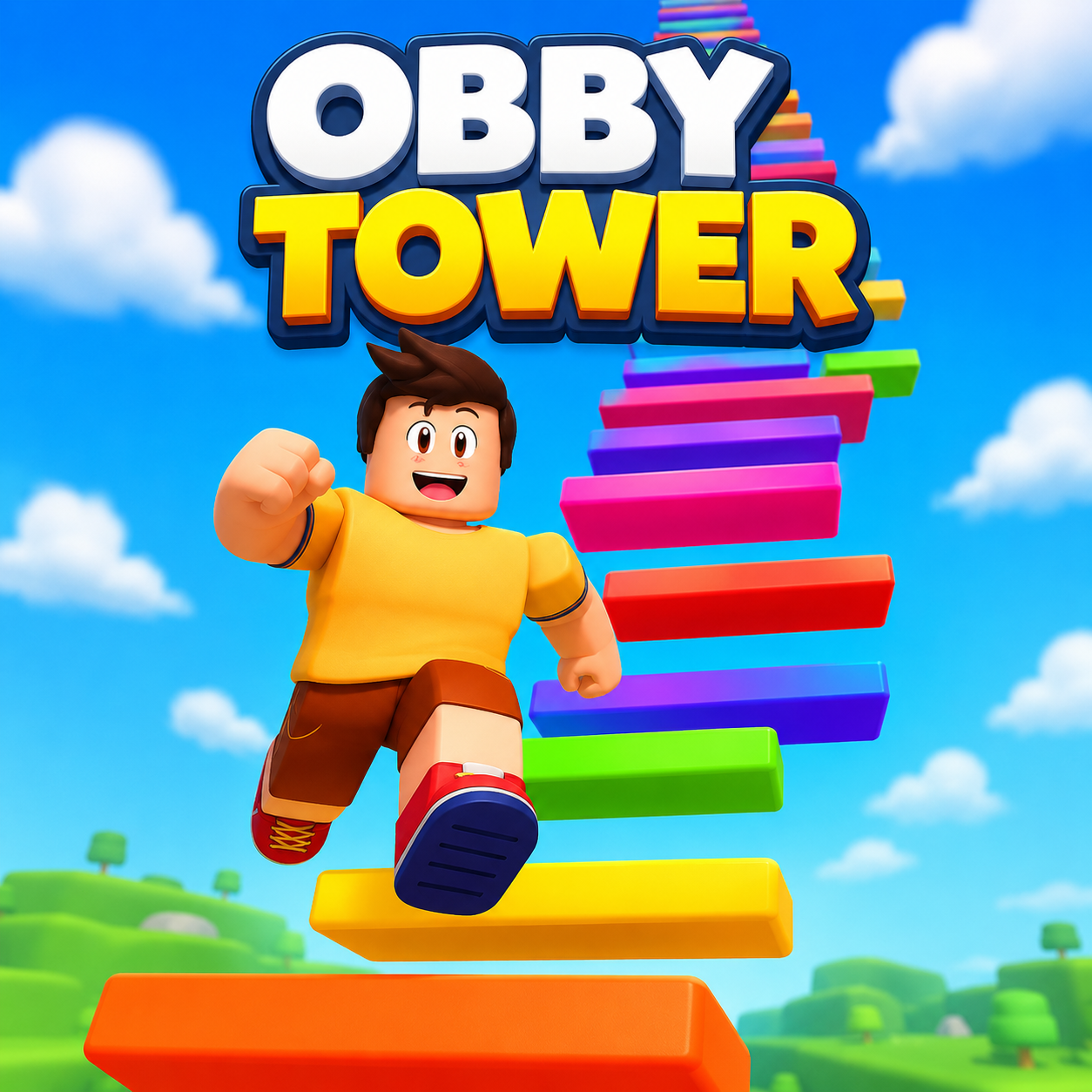
Obby Tower delivers an intriguing blend of agility-based jumping and intellectual challenges, marking itself as a trial of both physical skill and mental sharpness. The experience commences as players are placed within a three-dimensional track suspended high above the ground, where the progression route consists of a series of hovering platforms, each equipped with its own distinct set of obstacles. In contrast to conventional parkour games that depend solely on split-second reactions and rhythm, Obby Tower embeds straightforward arithmetic riddles straight into the setting, compelling participants to resolve equations in order to unlock barriers or select the appropriate landing pads. This design fosters a cadence that alternates between unadulterated leaping and moments of calculated reasoning, thereby offering a distinct flavor in the platforming category.
The construction of the game ensures that novices find it approachable, while still presenting a substantial learning curve that can push even seasoned players to their limits. By partitioning the extensive course into segments marked with checkpoints, the creators have alleviated the annoyance commonly linked to parkour titles, where an occasional slip can erase considerable advancement. Participants are given the liberty to determine their extent of dedication through a range of difficulty presets, enabling a personalized gameplay session. Obby Tower transcends being merely a test of quick reactions; it constitutes a thorough workout of spatial judgment, bodily awareness, and the capacity to maintain poise under strain, rendering it an appealing option for fans who relish grasping intricate mechanics and surmounting layered hurdles.
Key Features
- Divergent Pathway Structure: The title boasts two separate virtual arenas that serve as playgrounds: Playground and Rainbow. Each location possesses its own unique theme and distinct physical trials, effectively offering double the content within a single purchase.
- Graduated Challenge Settings: A versatile three-level difficulty configuration (Casual, Moderate, Expert) permits users to customize the game's intensity, ensuring it is equally amenable to beginners and demanding for those craving a rigorous skill test. This mechanism enables efficient onboarding for less seasoned individuals while providing a harsher environment for experts.
- Embedded Educational Elements: Obby Tower conspicuously incorporates problem-solving via numerical challenges. Players encounter these in three principal manners: passing through gated areas that require a correct answer, being catapulted onto specific numbered pads, or interacting with multiple-option interface screens.
- Responsive Character Manipulation: Accurate handling forms the foundation of the gameplay. The command set is comprehensive, allowing movement, leaping, dashing, and camera adjustment. A toggle permits both stationary and smooth visuals—first-person and third-person perspectives—accommodating diverse user tastes.
- Progressive Saving Mechanism: Save points indicated by a rotating "C" symbol allow players to secure their position at regular intervals along the course. Combined with a "Top Bar" visual indicator that displays overall completion percentage, this feature instills a sense of steadiness and reduces the repercussions of each blunder.
- Dynamic World Interactions: These stages are not inert. They are filled with trapdoors, spinning crossbars, narrow planks, and various other moving impediments. The interactive environments respond to different forms of damage and timing, ensuring substantial replay value.
Precautions/Tips
Achieving success in Obby Tower demands a tactical approach as much as nimble reflexes. One critical aspect is camera management; it becomes nearly impossible to accurately gauge a leap if the next landing spot is out of sight. It is prudent to first reposition the camera to encompass the upcoming objective. Ensure that you trigger the checkpoint prior to taking any daring maneuvers, as making physical contact with the marker is required—simply being close to it does not suffice. A tumble occurring after you have passed a checkpoint can wipe out your entire advancement, so always verify visually when the checkpoint begins to spin and resets your respawn location.
Allocate your sprint energy wisely. Recklessly dashing throughout a floating course makes it challenging to execute last-second corrections. Reserve your burst acceleration only for particularly long-distance jumps; maintaining a constant run during other sections might cause you to overshoot and plunge from a narrow ledge. Your camera positioning essentially governs your jump accuracy. Additionally, take a beat to halt and compute the answer for each puzzle before acting. The arithmetic itself is not the principal difficulty, but rather integrating it without sacrificing your spatial orientation. Prior to making a selection, identify a calm spot where you can safely land and think.
For those who are new, start with the Casual difficulty setting. This tier allows you to cultivate an intuitive sense of leap distances and control responsiveness without being swamped by environmental hazards. Bear in mind that harder modes do not merely adjust numerical values—they can modify the layout of the course and increase the density of dangers, requiring superior accuracy and timing. Should you fall, do not panic. The checkpoint system is engineered to soften the blow. Take a brief pause to orient yourself using the progress indicator and mentally prepare for the next segment—a quick mental walkthrough of a tricky landing or a logic problem can greatly enhance your consistency. Also, remember to employ the pause option (press Enter) to rest or review the scenario without the pressure of movement.
Obby Tower Frequently Asked Questions
Q: What is Obby Tower?
A: Obby Tower is a three-dimensional platforming experience that merges precise parkour mechanics with straightforward arithmetic challenges. Your primary goal is to traverse an extended sequence of suspended platforms, navigate through various impediments, and ultimately arrive at the finish line.
Q: What sets Obby Tower apart from other parkour titles?
A: Unlike many games in the genre, Obby Tower does not rely solely on leaping. Certain segments demand careful management of velocity and orientation, while others require solving a mathematical expression prior to advancing. Checkpoints partition the route into smaller, more digestible portions, ensuring that a single misstep does not necessarily negate all of your prior progress.
Q: Which obstacle courses are featured in Obby Tower?
A: At the outset, you have the option to choose between two distinct tracks: Playground and Rainbow. Each track offers its own unique configuration of vividly colored platforms, chasms, hazards, and dynamic components.
Q: What difficulty settings are available for selection?
A: You may opt for Easy, Medium, or Hard difficulty levels. Easy serves as an ideal entry point for familiarizing yourself with the controls and gauging jump distances. Once your movement becomes more reliable, Medium and Hard present opportunities to challenge your timing and exactness.
Q: What kinds of obstacles will appear during the parkour segments?
A: Expect to encounter trap doors, spinning bars, slender walkways, and moving hazards. Some leaps can be executed from a stationary stance, whereas wider gaps might necessitate a brief sprint to generate sufficient momentum.
Q: How significant is camera positioning in Obby Tower?
A: Camera placement holds equal importance to character movement. Prior to making a jump, rotate the camera toward your intended landing spot and verify that your character is oriented correctly. An unfavorable angle can cause you to overshoot the platform even if the distance is accurately judged.
Q: Should I maintain a constant sprint while playing?
A: No. Sprint only when additional momentum is essential. Running continuously makes it challenging to halt on compact platforms and heightens the likelihood of slipping off an edge.
Q: In what formats are the math puzzles delivered?
A: The arithmetic challenges appear in three primary configurations:
- Pass through the gate that displays the correct response.
- Leap onto the platform bearing the accurate numeral.
- Stand on a translucent platform and select an answer from a multiple-choice panel.
Q: How should I tackle the math puzzles?
A: The computations are uncomplicated, yet they disrupt the flow of the parkour. Decelerate, examine the full equation, and determine the solution before choosing a gate or platform.
Q: How do checkpoints function in Obby Tower?
A: Checkpoints are indicated by a rotating "C" symbol. Touch the marker to activate it and preserve your current location. Should you fall afterward, you can restart from the most recent checkpoint rather than going back to the start.
Q: Is there any special action required to activate a checkpoint?
A: Yes. You must make direct physical contact with every checkpoint you encounter. Merely approaching the marker may not trigger its activation.
Q: How can I monitor my advancement through the course?
A: A progress indicator located at the top of the screen displays the percentage of the course you have completed. Utilize this to gauge the remaining distance and prepare for upcoming sections.
Q: What are the control inputs for Obby Tower?
A: The control scheme is as follows:
- WASD: Move
- Space: Jump
- Shift: Sprint
- Mouse or Arrow Keys: Look around
- Enter: Pause the game
- V: Toggle between first-person and third-person perspectives
Q: Is it possible to alternate between first-person and third-person views?
A: Absolutely. Press the V key to switch between the two camera modes.
Q: What are some games similar to Obby Tower?
A: Comparable titles include:
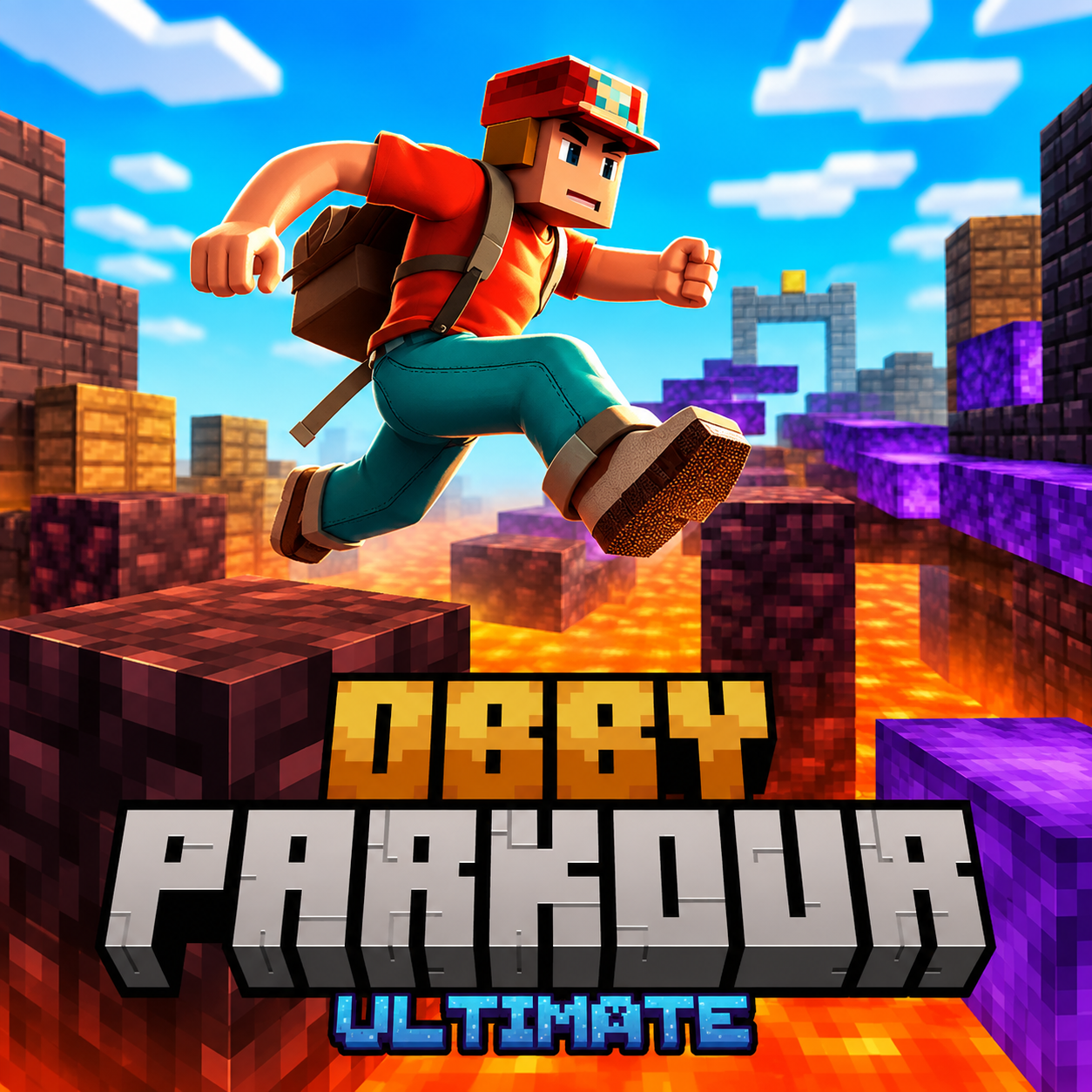
- Obby Parkour Ultimate: Navigate through 35 vibrant parkour stages, dodge hazards, gather coins, and unlock additional characters.
- Ragdoll Parkour Simulator: Ascend a suspended 3D course filled with narrow beams, unsteady platforms, vertical structures, and wide voids.
- Only Up: Attempt a single continuous climb across pipes, trains, beams, and floating objects, where a fall can wipe out substantial progress.
Q: Which categories does Obby Tower fall under?
A: Obby Tower is classified as an Adventure, jumping, 3D, parkour, and skill-based game.
Q: What occurs if I fall after passing a checkpoint?
A: If you fall subsequent to activating a checkpoint, you can resume from the most recent checkpoint instead of restarting from the beginning of the course.