




Fruit Ninja Mods Game
Zombie Battle Royale

Dash Masters
Zombie Dash
Rainbow Tsunami
Shapik The Quest

Do Dragons Exist
Goat Rampage
Tower Rise

Horror Nun 2

Sprunki Square Shifted
Obby Survive Parkour

Bees Empire Clicker

Paint Or Hunt

Super Bear Adventure
Brave Squad

Sprunki Hyper Shifted Phase 3 Remastered

Left Or Right Spranki Beats

1 Speed Keyboard Lucky Escape
Traffic Racing
Rider Rush
How To Play Fruit Ninja
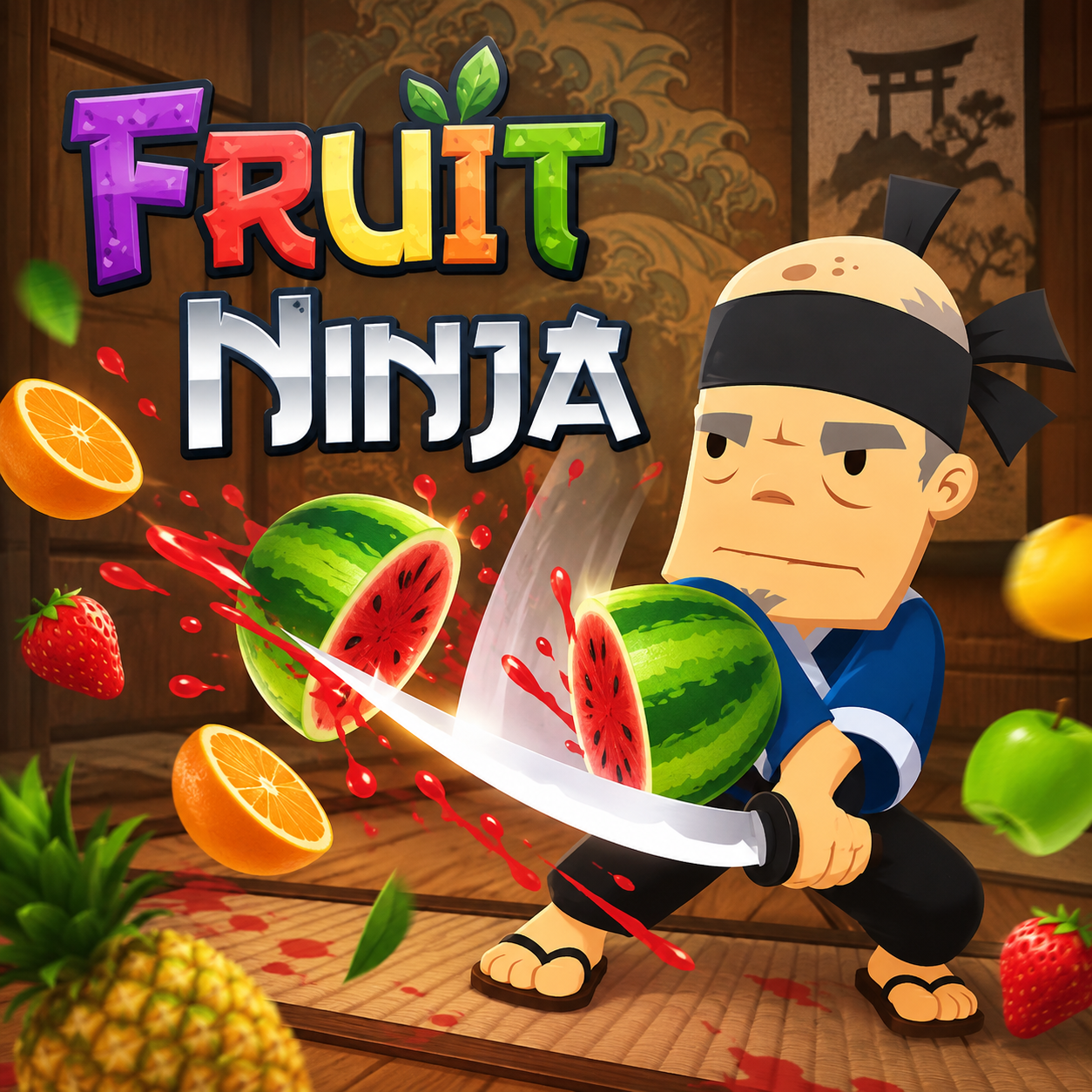
Grasping the fundamental mechanics of Fruit Ninja is straightforward, yet achieving true mastery demands considerable practice. The player's task is to slice fruit as it is propelled upward from the lower portion of the screen. Every fruit follows a parabolic flight path: ascending, losing momentum near the apex of its curve, then descending with increasing speed. In order to make a successful cut, the player must guide the blade across the fruit's visible surface. On a desktop computer, this involves holding down the left mouse button and moving the cursor. On a phone or tablet, the player merely drags a finger over the display.
The course taken by the blade carries as much weight as the timing of the strike. Since the slicing motion is uninterrupted, one continuous swipe can travel through multiple fruit items within a single gesture. This principle serves as the bedrock of the combo system. Cutting several targets with one swipe yields a higher score than handling them separately, and experienced players deliberately plan their cuts to strike numerous pieces simultaneously. Nevertheless, the presence of bombs cannot be overlooked. Bombs are visually unmistakable hazards that terminate the round in Classic mode, while in Arcade mode they subtract points. An overly broad swipe can inadvertently hit a bomb lurking just beyond the intended path.
Successful play starts with careful observation. Because fruit decelerates at the highest point of its flight, that moment often offers the clearest view of its position and the safest angle to strike. If the player delays only a fraction of a second longer, several pieces may converge, making a diagonal stroke particularly advantageous. Conversely, excessive hesitation may cause a fruit to drop beyond reach. Every movement therefore demands a delicate equilibrium between speed and accuracy.
Classic mode lacks any sort of countdown, fostering a more deliberate and measured play style. The main objective is to sustain the round by steering clear of errors. Allowing three fruits to descend untouched ends the game, and contacting a bomb brings it to an abrupt halt. For this reason, it is sometimes wiser to permit a difficult fruit to slip away if attempting to slice it would force the blade through a nearby explosive. Zen mode, on the other hand, eliminates bombs entirely and imposes no penalty for missed fruit. This results in a relaxed setting in which players can dedicate themselves to clean, precisely timed strokes and develop the ability to group multiple targets into one combo.
Arcade mode introduces a different set of conditions, incorporating a timer and a score penalty for bombs. Ignoring dropped fruit is acceptable, which lets the player devote full attention to racking up points with maximum speed. The inclusion of unique bananas, including Freeze and Double Points, adds another strategic dimension. Freeze slightly decelerates the action, whereas Double Points increases the value of any fruit sliced during its duration. Determining the right moments to pursue these power-ups versus focusing on keeping the combo streak alive is essential for mastering Arcade mode.
Fruit Ninja Wiki
Summary
Fruit Ninja is a precision-oriented action game that condenses the classic arcade-slicing concept into a trial of timing, spatial perception, and measured intensity. On the surface, the objective is straightforward: fruit is tossed into the air, and the player must cut as many items as possible while steering clear of hazards. However, the real complexity emerges from analyzing the flight path of every object on display, determining when to attempt a sweeping slash, and recognizing when a solitary, well-placed cut is more valuable than a hazardous multi-fruit burst.
The blade in Fruit Ninja mirrors the precise route drawn by the mouse or fingertip, so every cut represents a direct reflection of the player's intention. Fruit ascends from the lower edge of the screen, slows down near the peak of its trajectory, and then descends beyond reach. This sequence produces an inherent cadence: early slashes are low-risk but yield modest rewards, while holding off until several pieces converge offers the chance for substantially larger combo totals. Bombs are scattered throughout the flying clutter and must never be touched, introducing a layer of threat evaluation into every movement.
Fruit Ninja includes three separate modes, each built around a distinct goal and scoring approach. Classic mode centers on endurance with no countdown; the session ends only after three fruits are missed or a single bomb connects. Zen mode delivers a 90-second, bomb-free setting for players who wish to concentrate on pristine technique and combo chains. Arcade mode unfolds as a 60-second rush where dropped fruit incurs no punishment, bombs reduce points instead of terminating the run, and bonus bananas can dramatically reshape the tempo. Together, these options convert a simple slicing mechanic into a flexible skill-based title that accommodates both careful planners and daring score seekers.
For dedicated gaming fans, Fruit Ninja goes far beyond a casual time-killer. It incentivizes pattern recognition, precise hand-eye coordination, and composed strategic thinking. The controls are instantly graspable, yet the score mechanics and hazard arrangements ensure that true proficiency demands sustained focus and purposeful repetition.
Key Features
The structure of Fruit Ninja relies on a handful of central features that produce a surprisingly deep gameplay experience. The most apparent element is the intuitive swipe-based cutting mechanism. Because the blade follows the player's exact input trajectory, there is no animation lag or projectile delay between thought and execution. This immediate control approach makes the game simple to pick up while preserving a meaningful ceiling for mastery.
The three play modes form the heart of the title's appeal. Classic mode presents an survive-as-long-as-possible challenge. With no timer, each action carries consequence: a single error can terminate the run, yet a slow, methodical style can keep it going indefinitely. Zen mode offers a 90-second soothing interval free of bombs and miss-related penalties. It serves as the perfect practice arena for learning fruit trajectories and refining combo timing. Arcade mode, by contrast, is a 60-second scoring burst. The absence of miss penalties encourages aggressive play, while the point deduction for bombs prevents players from throwing caution entirely to the wind.
Combo scoring stands out as another key component. When multiple fruits are sliced within one unbroken stroke, the point payout is significantly larger than what separate cuts would provide. This system pushes the player to think in terms of overall patterns rather than isolated swipes. High-performing sessions are constructed around long, purposeful diagonal motions that sweep across the top region of the screen, where fruit frequently gathers. Balancing speed and precision during these movements creates an ongoing intellectual challenge.
Bombs inject a risk-versus-reward dynamic into every swipe. They are intentionally inserted among the fruit, compelling the player to monitor the whole display constantly. In Classic mode, touching a bomb is instantly fatal. In Arcade mode, a bomb merely subtracts points and the game continues. This distinction shapes the player's approach to each mode: careful restraint controls Classic, while purposeful risk-taking defines Arcade.
Finally, the cross-platform controls make Fruit Ninja a highly adaptable experience. The game performs equally well on a computer using a mouse and on a touchscreen using a finger. The fundamental mechanics stay identical, so abilities gained on one device transfer seamlessly to the other. That accessibility, combined with the intricacy of the scoring systems, makes Fruit Ninja a rewarding experience for anyone who appreciates games that are effortless to learn yet difficult to fully conquer.
Precautions/Tips
The foremost precaution in Fruit Ninja is to examine the entire intended path before committing to a cut. Since the blade destroys anything along its course, a broad, careless swing can easily strike a bomb. Players should mentally draw a line from the start of the planned swipe to its endpoint and confirm that every object within that line is safe to strike. If a bomb sits close to a fruit cluster, shorten the stroke and accept a lower combo. A modest score is always better than forfeiting the entire game session.
In Classic mode, staying alive should be the top priority. The game does not finish after a single missed fruit; instead, it concludes after three misses or one bomb hit. Consequently, a deliberate miss is sometimes the smartest choice. If a fruit happens to be directly adjacent to a bomb, or if the only route to it forces a cut across an explosive, allowing that fruit to drop is the wiser move. Absorbing one miss is far less harmful than wiping out the whole run on a bomb. Novices often make the mistake of attempting to slice every piece of fruit in view, but seasoned players recognize that certain fruit is deliberately arranged as a trap.
Zen mode is the best environment for practicing and sharpening abilities. By removing bombs and eliminating any penalty for missed fruit, it isolates the core elements of timing and combo construction. Those who have trouble striking multiple targets should use Zen mode to test different swipe angles and stroke lengths. Take note of where fruit reaches its slowest point, because that is the most favorable moment to make contact. Repeating diagonal cuts from the lower corners toward the upper middle can ingrain the muscle memory necessary for high-scoring performances.
In Arcade mode, the main objective is rapid scoring, but this does not mean bombs should be disregarded. A bomb costs only 10 points, whereas a successful combo can yield far more. This makes it occasionally worthwhile to accept a dangerous swipe if the payoff is a large multi-fruit chain. Still, players should steer clear of unnecessary bomb collisions, particularly when the Freeze or Double Points banana is in effect. During a Double Points bonus, every fruit is worth twice as much, so avoiding bombs becomes even more critical. Reserve aggressive moves for moments when the possible gain clearly exceeds the cost of a mistake.
Finally, keep in mind that the blade can be as narrow or as sweeping as the player chooses. Short, quick cuts are ideal for crowded zones where hidden bombs are probable. Longer slashes create stronger combo momentum but span more ground and therefore bring greater risk. Adjust the length and direction of each swipe based on the current arrangement. By remaining flexible and always scanning the screen before acting, players can convert a simple gesture into a high-scoring, bomb-free performance.
Fruit Ninja Frequently Asked Questions
Q: What is Fruit Ninja?
A: Fruit Ninja is a game centered on skill, in which you slice through airborne fruit as it moves across the display, create multiple-hit chains, and steer clear of explosives hidden within each wave. The title features three distinct play styles, each with its own set of rules to deliver a range of gameplay experiences.
Q: What are the three game modes in Fruit Ninja?
A: The three available modes are Classic, Zen, and Arcade. Classic operates without a timer and concludes when you fail to catch three fruit or strike an explosive. Zen lasts for 90 seconds, containing no bombs and imposing no penalties for fruit that drop. Arcade is a 60-second, score-oriented contest that does not penalize dropped fruit, though striking a bomb costs 10 points.
Q: How does Classic mode work?
A: Classic does not enforce any time constraint. The session comes to an end once three fruit are missed or an explosive is hit, unless a safeguard item intervenes. Maintaining precision is essential to prolonging your performance, so allowing a single awkward fruit to fall can be a wiser choice than slicing through a bomb.
Q: How does Zen mode work?
A: Zen grants you 90 seconds free of explosives and with no consequences for fruit that escape unsliced. It is intended for refining clean cutting motions and arranging several targets into combination strikes without the pressure of surviving.
Q: How does Arcade mode work?
A: Arcade is a 60-second scoring rush that includes special bonuses and imposes no penalty for dropped fruit. Bombs lower your score by 10 points rather than terminating the session, so the main objective is to gather points rapidly while limiting expensive mistakes.
Q: What are the controls on desktop?
A: When playing on a computer, press and hold the left mouse button, then drag your cursor through the fruit to slice it.
Q: What are the controls on mobile or tablet?
A: On a phone or tablet, simply move your finger across the touchscreen in a swiping motion to cut through fruit.
Q: How do combos work in Fruit Ninja?
A: Your blade follows the exact line you trace, so one fluid movement can pass through multiple pieces of fruit and grant you combo rewards. Using extended, angled cuts can help you connect with several fruits at once when the trajectory is open.
Q: How do bombs affect gameplay?
A: Bombs add difficulty to your timing decisions. A broad sweeping cut may capture a full cluster of fruit, yet it may also strike an explosive nearby. In Classic, touching a bomb instantly ends the game. In Arcade, hitting a bomb costs 10 points rather than concluding the match. Zen includes no bombs whatsoever.
Q: What are the Arcade bonus items?
A: Arcade mode introduces Freeze and Double Points bananas. Slicing the Freeze banana slows down the action, whereas slicing the Double Points banana boosts the amount of scoring you can achieve.
Q: How does fruit movement work?
A: Fruit ascends from the bottom portion of the screen, decelerates as it reaches the peak of its flight, and then descends beyond reach. When fruit is near the highest point of its arc, following its motion becomes simpler, offering a convenient opportunity to plan your slice.
Q: What tips are there for a higher score?
A: Helpful advice includes setting up combos through long, angled swipes; examining the route for bombs before you commit to a slice; giving priority to Arcade extras such as Freeze and Double Points bananas; and spending time in Zen to understand fruit paths and refine your timing prior to moving on to Classic or Arcade.
Q: When is the best time to strike fruit?
A: Slicing right away helps you connect with individual pieces, whereas pausing for a moment can allow several targets to come within range of a single pass. Near the apex of their trajectory, fruit becomes easier to follow, which makes that phase ideal for assessing your cutting angle.
Q: Should I always go for large combos?
A: Not necessarily. Review the complete path before making your move, and employ shorter strokes when hazards are positioned close to the fruit. Strong performances depend on recognizing when a big combo is truly worth the risk, particularly when explosives are in the vicinity.