


Dash Masters Mods Game
Zombie Dash
Rainbow Tsunami
Shapik The Quest

Do Dragons Exist
Goat Rampage
Tower Rise
Horror Nun 2
Sprunki Square Shifted
Obby Survive Parkour

Bees Empire Clicker

Paint Or Hunt
Super Bear Adventure
Brave Squad
Sprunki Hyper Shifted Phase 3 Remastered
Left Or Right Spranki Beats
1 Speed Keyboard Lucky Escape
Traffic Racing
Rider Rush
Sprunki Phase 9 Ggtp
Rooster Road
How To Play Dash Masters
At its core, Dash Masters is a single-button action game. On a computer, clicking the mouse, pressing the Spacebar, or tapping the Up Arrow key makes the player’s icon jump. On a mobile device, a quick tap on the touchscreen performs the same action. The character automatically moves forward through the level, meaning the player has only one task: land well-timed jumps at the right moments. Scattered across every stage are hazards such as spikes, rotating saws, and moving platforms. Any contact with these obstacles immediately ends the run and returns the player to the very beginning. Because a single mistake is enough to force a full restart, precise timing becomes the most valuable skill in the game.
The arrangement of these dangers is heavily synchronized with the background music, and the audio track often functions as a clue for upcoming actions. Many critical jumps are placed right on prominent beats or musical accents, so listening to the rhythm can help you anticipate when to leap. For particularly difficult portions, Practice Mode lets you set checkpoints, which gives you a chance to focus on demanding segments without restarting the entire level again. Using this tool wisely can greatly speed up the learning process.
Ultimately, Dash Masters rewards patience, observation, and a strong sense of rhythm. Each failure provides information about the obstacle layout and the exact timing required, allowing you to refine your approach on the next attempt. The game’s polished controls and rhythmic level design create a satisfying cycle of trial, error, and eventual mastery, making it an excellent choice for fans of precision platformers and music-driven challenges.
Dash Masters Wiki
Dash Masters: A Precision-Driven Rhythm Platformer
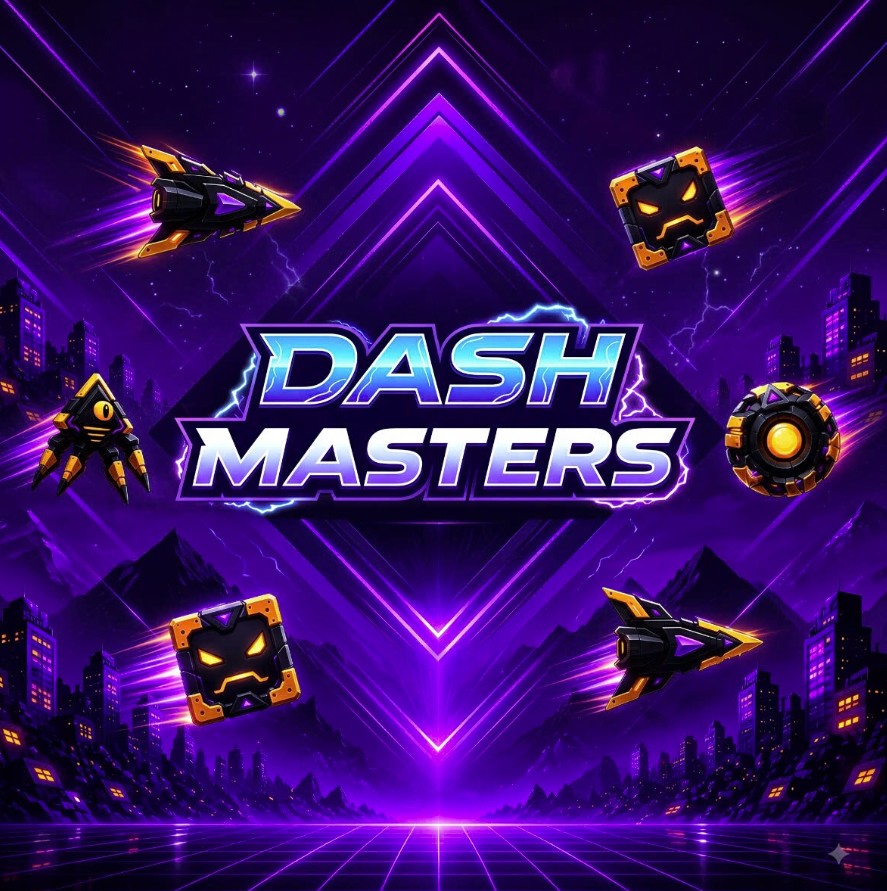
Dash Masters is a high-energy rhythm platformer that has captured the attention of gamers who relish demanding, precision-oriented play. Drawing clear inspiration from the Geometry Dash school of design, the game discards unnecessary mechanics and centers on one of the purest challenges in gaming: advancing forward relentlessly while conquering every obstacle in your path. The outcome is an experience that couples simplicity with depth, requiring not only nimble fingers but also careful timing and pattern recognition. Whether you are a veteran of rhythm games or a newcomer seeking an intense arcade challenge, Dash Masters delivers a polished and satisfying environment. The following sections examine the game's core premise, gameplay, standout qualities, and essential advice for optimizing your performance.
Summary
Dash Masters is a fast-paced rhythm platformer built around a constantly moving icon that must traverse obstacle-dense levels. Combining the precision of geometric platforming with the auditory feedback of a musical score, the game demands timing, memory, and split-second reactions. Players face a gauntlet of spikes, saws, moving hazards, and gravity-defying portals, all while the soundtrack dictates the pace. The core objective is straightforward: guide the icon from each level's start to its finish without crashing. Every attempt concludes in a quick restart, pushing players to learn from errors and gradually map the correct route. Inspired by the core mechanics of Geometry Dash, Dash Masters distills the rhythm-platformer formula into a polished and accessible package. It rewards consistent rhythm and careful observation rather than random input spamming. The game's design ensures every death imparts a lesson, and every victory is earned through genuine mastery.
How to Play
Getting into Dash Masters is simple; mastering it is another matter. The controls are minimal. On PC, you can use the mouse, the Spacebar, or the Up Arrow key to make your icon jump. On mobile devices, tapping the screen triggers the same action. Since your character moves forward automatically, there is no need to concern yourself with acceleration or braking. Instead, the entire gameplay loop is reduced to a single decision: when to jump.
That simplicity is deceptive. Every spike, saw, and platform must be timed with exactness. A jump executed one frame too early or too late typically ends the run. The game steadily introduces new mechanics to keep you alert. Portals are the most significant of these. Some reverse gravity, forcing you to reorient your perspective instantly. Others alter your icon's speed, meaning the distance covered by a jump changes mid-run. Some portals shift your icon into varied forms, such as a cube or a ship-like state, each featuring unique physics. These transformations demand rapid adaptation and a deep understanding of the game's movement fundamentals.
One of the most valuable learning tools is Practice Mode. In this mode, you can place checkpoints at any point within a level. This enables you to target a specific hard segment without replaying the entire stage from the beginning. Practice Mode is not a crutch but a strategic requirement. The game's levels are long and exacting, and trying to learn a late-game section through repeated full runs is inefficient. By isolating the troublesome portions, you can devote focused attention to the precise jump timings and portal transitions. Once those moments become second nature, you can connect everything into a complete run.
The most important skill to develop is rhythm. Because Dash Masters synchronizes obstacles with musical beats, players who rely solely on visual reaction often find themselves overwhelmed. Instead, subconsciously counting through the music allows you to commit jump timings to memory. The early stages ease you into this mindset with wider gaps and slower tempos. Later levels demand faster and more precise responses, and the music becomes an essential guide rather than merely background audio.
Key Features
Dash Masters may appear minimal, but its feature set is thoughtfully engineered to generate depth and variety within an ostensibly simple framework. Below are the defining aspects of the experience.
-
Simple yet responsive controls: The control layout is deliberately bare-bones. With just a single jump input on PC or mobile, the game eliminates mechanical complexity and focuses difficulty on timing. The resulting precision is gratifying for players who value skill-based arcade styling.
-
Continuous forward motion: The icon never stops moving, and you cannot adjust its speed or trajectory. Instead, you must plan your jumps based on what appears ahead. This constraint is the heart of the challenge. It compels players to think in advance, observing the path and mentally preparing for the next obstacle.
-
Portals and transformation mechanics: Certain sections contain portals that completely change how the icon behaves. A gravity reversal portal flips the world upside down, requiring landings on ceilings. Speed portals accelerate or decelerate the action, altering the timing of every subsequent jump. These elements prevent the game from feeling monotonous and add an extra layer of strategic consideration, particularly when multiple portals appear in quick succession.
-
Rhythm-based level design: The game's obstacles are not randomly placed. Stage layouts are synchronized with the music, so many jumps feel like notes in a composition. This synchronization goes beyond aesthetics—it offers a reliable timing reference. Players who can feel the beat will find the game more intuitive and less chaotic.
-
Practice Mode: This mode is invaluable for players serious about clearing difficult levels. It allows you to set checkpoints and repeatedly attempt a short segment without starting from scratch. Far from being an optional extra, it effectively functions as a training tool for pattern recognition and muscle memory development.
-
Scalable difficulty curve: Dash Masters starts forgivingly enough to teach the basics, then gradually introduces faster tempos, denser hazards, and more intricate portal combinations. The curve is designed to make you experience genuine improvement as you progress, while still presenting a formidable challenge to veteran players.
Precautions/Tips
Success in Dash Masters hinges on mental preparation, familiarity, and controlled reflexes. The first and most important piece of guidance is to treat failure as a learning mechanism, not as a setback. Every crash is a data point: it tells you that a jump was too early, too late, or mistimed relative to the music. The sooner you embrace death as a natural part of the learning process, the quicker you will advance.
One of the most effective strategies is to listen to the music actively. Rather than focusing only on the visual hazards, try to recognize the underlying beat structure. Many obstacles fall on downbeats and rhythmic accents. If you find yourself missing the same jump repeatedly, try closing your eyes for a moment and feeling the pulse of the track. You may find that your body instinctively knows when to jump, even before your conscious mind processes the obstacle. This type of audio-motor coordination is a core component of the Dash Masters experience.
For sections involving portals, it is advisable to break them down mentally. When you enter a gravity reversal or a speed shift, the geometry of the course remains the same, but your relationship to it changes dramatically. Practice these transitions in Practice Mode until your hands adjust naturally. It also helps to keep a peripheral awareness of what comes immediately after a portal, because your first jump following a mechanic change is often the most dangerous.
Precautions/Tips
Dash Masters can be a mentally demanding game. Given the minimal margin for error and the requirement for precise timing, frustration can quickly surface. The most important tip is to remain calm and treat each attempt as an experiment. Instead of expecting immediate completion, focus on advancing one obstacle at a time. Memorizing a level's pattern is not a shortcut but an essential facet of the intended experience.
When approaching a new section, try to identify a reference point—a particular musical beat, a visual cue on the ground, or a platform edge—that triggers your jump. Anchoring your timing to consistent signals reduces the chance of jumping too early or too late under pressure. The same logic applies when a speed portal changes the pace; the visual cue and the rhythm both shift, so do not rely purely on what worked in the previous segment.
For players who feel stuck, the best course of action is to step away for a brief rest. Fatigue dulls reflexes and concentration, and continuing to play while frustrated often leads to sloppy inputs. Returning with a fresh mindset can make a difficult portion feel considerably more manageable. Also, pay attention to your screen and input device. A clean, responsive mouse or a stable touchscreen makes a noticeable difference in a game that measures timing in fractions of a second.
Finally, do not ignore the audio. Playing with the sound off removes one of the most significant feedback systems the game provides. The music is not decorative; it is a map to the level's design. For maximum control, keep the volume at a comfortable level and let the beat embed itself in your muscle memory. Over time, your jumps will feel less like calculations and more like instinctive responses—which is precisely the state of mind Dash Masters is designed to
Dash Masters Frequently Asked Questions
Q: What is Dash Masters?
A: Dash Masters is an energetic rhythm-based platformer that draws its core mechanics from Geometry Dash. You guide an ever-moving icon and must respond swiftly to oncoming dangers.
Q: What is the main goal in Dash Masters?
A: The primary objective is to make it from the start of a stage all the way to its conclusion without experiencing a crash.
Q: What are the basic controls on PC?
A: On a computer, jumping can be performed with either the mouse, the Spacebar, or the Up Arrow key.
Q: What are the controls on mobile?
A: On mobile devices, you simply touch the screen to jump or engage with interactive elements.
Q: Does the player character move automatically?
A: Indeed, your icon advances forward automatically at all times, requiring no manual steering.
Q: What types of obstacles can appear in Dash Masters?
A: You may encounter a variety of hazards, such as spikes, rotating saws, platforms, portals, and additional threats.
Q: How do portals affect gameplay?
A: Portals are capable of altering gravity, modifying your speed, or shifting your current movement form.
Q: How does music help in Dash Masters?
A: The soundtrack acts as a vital rhythmic guide, assisting you in predicting where many obstacles will appear and when to act.
Q: What is Practice Mode used for?
A: Practice Mode enables you to decrease the speed and tackle challenging segments step by step, proving especially useful when a particular section seems insurmountable.
Q: Does the difficulty change as you progress?
A: As you advance, the game introduces swifter movement and more complex level layouts, which makes every new attempt increasingly demanding.
Q: What makes Dash Masters rhythm-based?
A: The gameplay is closely synchronized with the music, and paying attention to rhythmic patterns helps you time your jumps accurately and foresee upcoming hazards.
Q: What is the best way to learn difficult patterns?
A: The most effective approach involves repeated attempts to memorize the layout, while Practice Mode allows you to break down and master each obstacle individually.